Waarom loophouding meer invloed heeft op blessurerisico dan je dure schoenen
Wanneer we spreken over blessurepreventie bij lopers, gaat het meestal over krachttraining, trainingsschema’s, rust en herstel, voeding en natuurlijk ook over loopschoenen.
Maar over één belangrijk aspect wordt opvallend weinig gesproken: loophouding.
Nochtans is je loophouding één van de belangrijkste factoren als het gaat over blessures en blessurepreventie.
Er is de voorbije jaren ontzettend veel onderzoek gedaan naar loopschoenen. Helpt meer demping? Helpt een anti-pronatieblok? Kunnen bepaalde schoentechnologieën de kans op blessures verkleinen? De merken die schoenen met demping ontwikkelen doen er alles aan om toch maar te bewijzen dat hun schoenen het risico op blessures zou doen dalen, maar geen enkel onderzoek slaagt daarin. In tegendeel zelfs. Ik verklaar...
De onderzoeken tonen telkens opnieuw aan dat die schoentechnologieën het verschil niet maken.
Wat wel telkens naar voren komt, is het belang van hoe je lichaam beweegt en hoe je de krachten van het lopen opvangt. Zo kan de conclusie van een onderzoek zijn dat lopen met die demping minder blessures uitlokt WANNEER ER MET EEN BEPAALDE HOUDING (hoge cadans, kort grondcontact, ...) WORDT GELOPEN. De houding is doorslaggevend, niet de schoen. Wat er zeker niet verteld wordt is dat die zwakke houding grotendeels het gevolg is van die dempende schoen en dus de dempende schoen onrechtstreeks het blessurerisico verhoogt.
Shoespiracy
Hoe komt komt dat er zo weinig over loophouding en looptechniek wordt gesproken, dat vind je veelvuldig terug op deze website. Het is een geheel van desinformatie vanuit de loopindustrie. Een conspiracy, of beter, Shoespiracy.
Wat gebeurt er bijvoorbeeld in een winkel? Een verkoper zget na analyse dat een bepaalde schoen je houding bijstuurt. Hij zegt niet dat je zelf aan je houding moet werken. Het is gemakkelijker om een nieuwe schoen met meer demping, meer ondersteuning of een nieuwe technologie te verkopen dan om mensen te leren hoe ze efficiënter kunnen lopen. Voor het eerste moeten je als klant gewoon even betalen aan de kassa, en voor het tweede is er kennis en volharding nodig.
Passieve versus actieve loophouding
Dat kun je heel mooi zien wanneer je twee verschillende loopstijlen naast elkaar in super slow motion bekijkt.
Bij de eerste manier landt de voet relatief ver vóór het lichaam. De voet wordt als het ware passief naar de grond gebracht. Dit noemen we overstriding. Schoenen met demping lokken overstriding uit. Zonder die dikke dempende zool zou je je voet niet op je hiel ver voor je lichaam laten landen. Bij die passieve houding is de achterste spierketen — onder andere de hamstrings en kuitspieren — veel minder actief.
Wanneer je daarentegen met een actievere cadans en een actieve voetplaatsing loopt, komt je voet veel meer onder je lichaam terecht. De achterste keten is op dat moment actief en trekt je voet als het ware naar beneden en onder je lichaam. Het verschil wordt heel duidelijk wanneer je naar de spieren kijkt in slow motion. Bij een passieve hiellanding zie je dat de spieren op het moment van de landing veel meer en langer gaan trillen. Wanneer de voet onder het lichaam landt, zie je iets helemaal anders: de spieren beginnen zich al aan te spannen nog vóór het grondcontact. Net dat is heel belangrijk. Er is een betere timing. Er is sprake van voorspanning in de spieren.
Timing van de spieren: Je lichaam bereidt zich voor op de impact.
Uit onderzoek naar onder andere blootsvoets lopen en biomechanica weten we dat die voorspanning van de spieren, of pre-tension, een belangrijke rol speelt in de manier waarop de schok wordt opgevangen. Het is dus niet alleen de demping van je schoen die bepaalt hoe de impact wordt verwerkt, maar ook de spanning in je spieren (vooral de spierspanning!) op het moment dat je voet de grond raakt.
Een eenvoudige vergelijking is die met een volleyballer. Stel dat je je arm gewoon ontspannen omhoog houdt en iemand slaat plots tegen je hand. Je arm vliegt dan naar achteren en de kracht komt hard aan in je schoudergewricht. Een volleyballer die zijn handen omhoog voor een blok op een smash, is klaar voor die impact. Zijn spieren zijn aangespannen en voorbereid op de impact. De kracht die op zijn lichaam komt, kan zelfs veel groter zijn dan in het eerste voorbeeld. Door zijn spierspanning vangen zijn spieren de schok op en minder het schoudergewricht.
Hetzelfde gebeurt tijdens het lopen. Wanneer je spieren op het juiste moment voldoende spanning hebben, kunnen ze de landingsimpact beter opvangen. Een goede loophouding zorgt dus voor een betere spierspanning op het moment van impact. En precies daarom is loophouding zo belangrijk wanneer we spreken over blessurepreventie bij lopers.
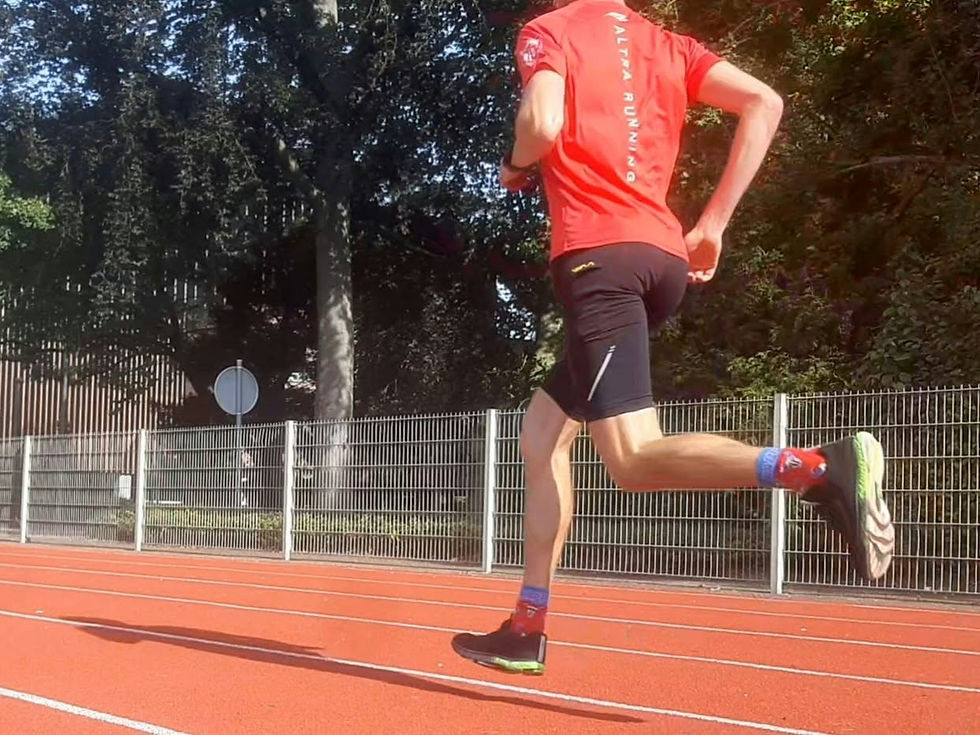
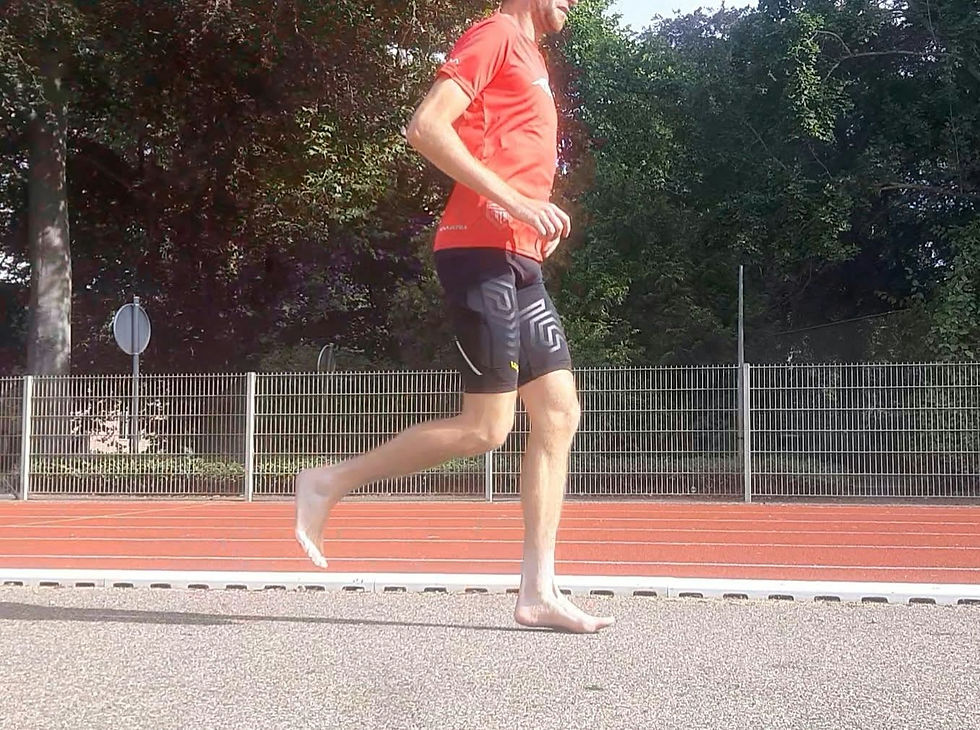
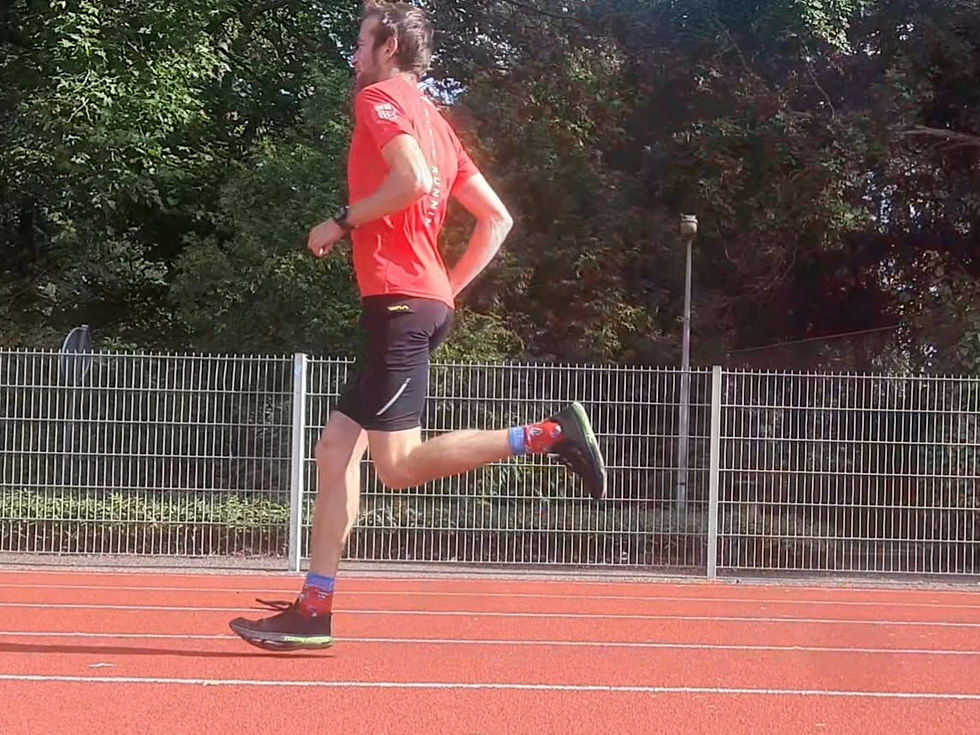
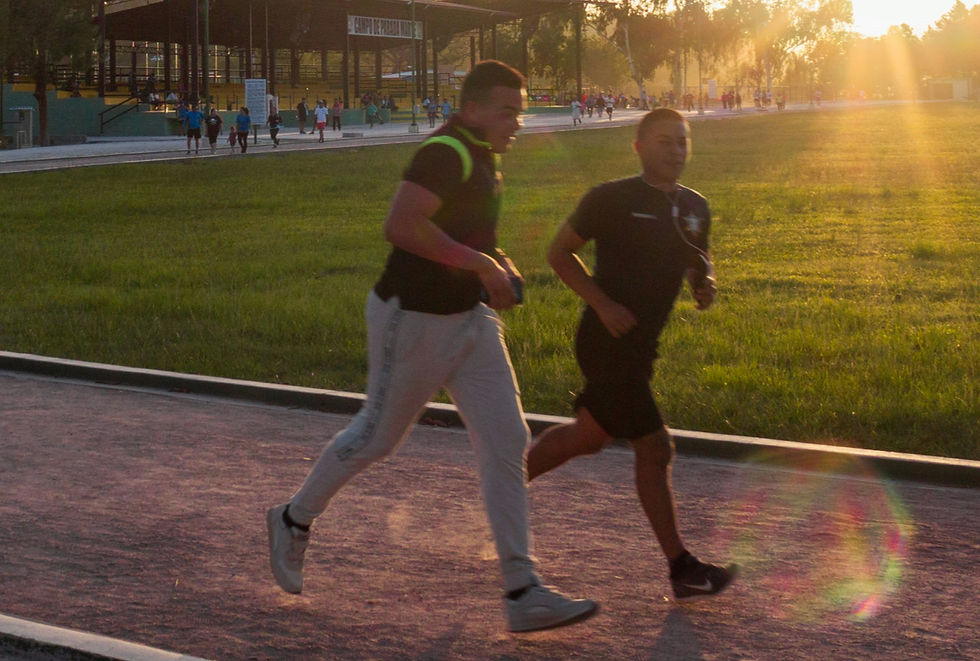
Bij een actieve voetplaatsing spant hamstring en kuit zich aan vóór het moment van grondcontact waardoor de impact door spieren worden opgevangen. Dempende schoenen lokken een passieve landing uit (zie rechtse foto), met grotere impact op de gewrichten en hoger blessurerisico tot gevolg.
Social media
🏃 Your cushioned shoes don't protect you against injuries. Here's why they don't. And why your running technique does!
👣 Voetplaatsing — een voet die ver vóór het lichaam landt, zorgt voor een passieve landing.
🔄 Overstriding — de voet valt als het ware passief naar de grond.
⚡ Actieve cadans — met een hogere cadans komt je voet sneller en actiever onder je lichaam.
💪 Spierspanning — bij een actieve voetplaatsing spannen je spieren zich al vóór het grondcontact op.
🧠 Impact — je spieren zijn voorbereid en kunnen de schok beter opvangen.
🦵 Stabiliteit — een goede spierspanning helpt je gewrichten beter uitgelijnd te houden.
👟 Niet alleen je schoen — het is niet enkel de demping van je schoen die bepaalt hoe je lichaam de impact opvangt.
👉 Je loophouding bepaalt mee hoe je lichaam met de krachten van het lopen omgaat.
Voor de overlay op de foto zou ik bij deze post heel kort gaan:
When we talk about injury prevention for runners, the conversation usually revolves around strength training, training schedules, rest and recovery, nutrition and, of course, running shoes.
But there is one important aspect that gets surprisingly little attention: running posture.
And yet, your running posture is one of the most important factors when it comes to injuries and injury prevention.
Over the past few years, an enormous amount of research has been done on running shoes. Does more cushioning help? Does an anti-pronation block help? Can certain shoe technologies reduce the risk of injuries? Brands that develop cushioned shoes do everything they can to prove that their shoes reduce the risk of injury, but no research has managed to demonstrate this. Quite the opposite, in fact. Let me explain...
Research repeatedly shows that these shoe technologies do not make the difference.
What does consistently emerge is the importance of how your body moves and how you absorb the forces generated by running. For example, a study may conclude that running with a certain type of cushioning causes fewer injuries WHEN RUNNING WITH A CERTAIN POSTURE (high cadence, short ground contact, etc.). The posture is decisive, not the shoe. What is certainly not mentioned is that this weak posture is largely caused by the cushioned shoe itself, meaning that the cushioned shoe indirectly increases the risk of injury.
Shoespiracy
Why is running posture and running technique discussed so little? You can find plenty of information about that throughout this website. It is an entire system of misinformation coming from the running industry. A conspiracy — or better yet, a Shoespiracy.
What happens, for examp e, in a running store? A salesperson analyses your running and tells you that a particular shoe will correct your posture. They don't tell you that you should work on your own running posture. It is much easier to sell someone a new shoe with more cushioning, more support or a new technology than it is to teach them how to run more efficiently. For the first, all you have to do as a customer is pay at the checkout. The second requires knowledge and perseverance.
Passive versus active running posture
You can see this very clearly when you watch two different running styles side by side in super slow motion. In the first style, the foot lands relatively far in front of the body. The foot is, so to speak, brought passively towards the ground. This is what we call overstriding. Cushioned shoes encourage overstriding. Without that thick cushioned sole, you would not place your foot far in front of your body and land on your heel. With this passive posture, the posterior chain — including the hamstrings and calf muscles — is much less active. When, on the other hand, you run with a higher cadence and active foot placement, your foot lands much more underneath your body. At that moment, the posterior chain is active and essentially pulls your foot down and underneath your body. The difference becomes very clear when you look at the muscles in slow motion. With a passive heel landing, you can see the muscles vibrating much more and for longer at the moment of impact. When the foot lands underneath the body, you see something completely different: the muscles begin to tense before the foot even makes contact with the ground. And that is extremely important.
There is better timing. There is pre-tension in the muscles.
Muscle timing: Your body prepares for impact
Research into barefoot running and biomechanics, among other things, shows that this pre-tension of the muscles, or pre-tension, plays an important role in how shock is absorbed.
So it is not only the cushioning of your shoe that determines how impact is processed, but also the tension in your muscles — especially muscle tension — at the moment your foot hits the ground.
A simple comparison is a volleyball player.
Imagine holding your arm up in a completely relaxed position and someone suddenly hits your hand. Your arm flies backwards and the force is transferred hard into your shoulder joint.
A volleyball player with their hands raised to block a smash is prepared for that impact. Their muscles are tense and ready for the impact.
The force acting on their body can even be much greater than in the first example. But because of their muscle tension, their muscles absorb the shock rather than the shoulder joint.
The same thing happens when running.
When your muscles have sufficient tension at the right moment, they can absorb the impact of landing more effectively.
Good running posture therefore creates better muscle tension at the moment of impact.
And that is exactly why running posture is so important when we talk about injury prevention for runners.
Running Posture and Injury Prevention
🏃 Why is running posture so important for injury prevention?
When we think about injury prevention, we often think about:
💪 Strength training🏋️ Training progression😴 Rest & recovery🥗 Nutrition👟 Running shoes
But running posture gets much less attention.
And yet, it is crucial.
👣 Foot placement — a foot landing far in front of the body creates a more passive landing.
🔄 Overstriding — the foot essentially falls passively towards the ground.
⚡ Active cadence — with a higher cadence, your foot moves more quickly and actively underneath your body.
💪 Muscle tension — with active foot placement, your muscles begin to tense before ground contact.
🧠 Impact — your muscles are prepared and can absorb the shock more effectively.
🦵 Stability — good muscle tension helps keep your joints better aligned.
👟 Not just your shoes — it is not only the cushioning of your shoes that determines how your body absorbs impact.
👉 Your running posture plays an important role in how your body deals with the forces of running.
Opmerkingen